Rethinking Early-Stage Design Discovery: Introducing WDWL.io
Design discovery is a notoriously brittle phase of the product lifecycle. For most teams, it exists in a blurry gap between “we should explore this idea” and “let’s build a prototype.” In traditional organizations, design discovery involves workshops, stakeholder reviews, whiteboard sketches, and a flurry of barely-structured conversation. In smaller organizations, the process often collapses into a single designer’s intuition—or, more commonly, into the informal preferences of whoever speaks first or loudest.
Over the past few years, we’ve seen LLMs enter the design process through tools like Figma’s AI features, prompt-driven UI generators, and AI-powered moodboard creators. These tools are useful, but they almost always operate within one workflow: generate a UI mock and react to it.
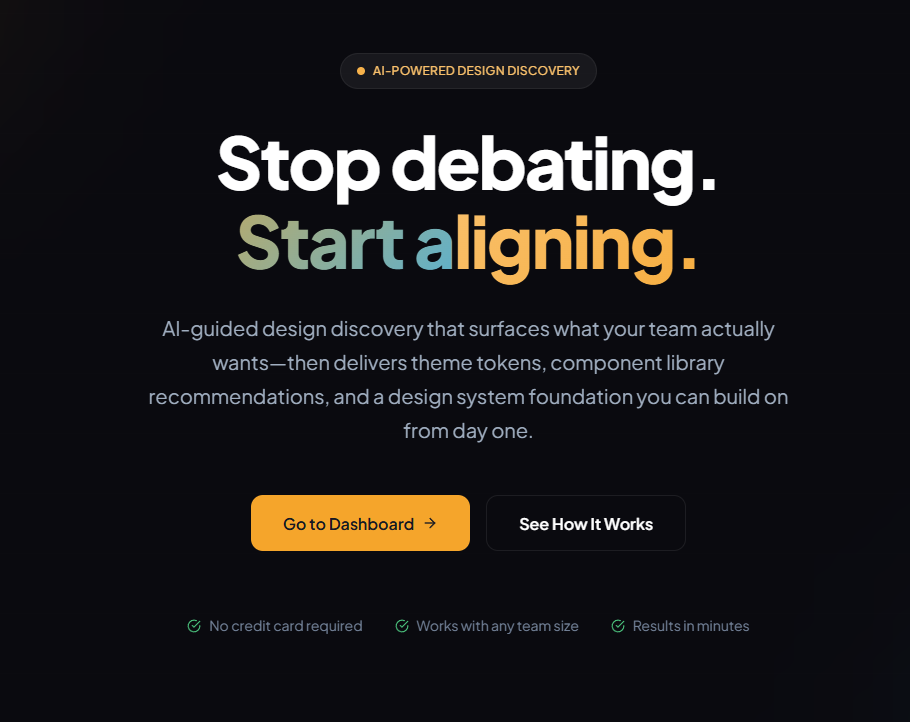
WDWL (What Do We Like?) was built to solve a more upstream problem:
How do teams explore design ideas without politics, bias, anchoring, or interpersonal influence—long before we draw anything?
This is not a Figma competitor, and it’s not a UI generator. It’s a lightweight thinking structure. A facilitator. A neutralizer. A way to evaluate design direction at the principle level instead of the artifact level.
This article explains:
- why early design exploration is fundamentally broken
- where bias actually comes from (and why it’s subtle)
- how WDWL reframes the discovery process
- specific, practical use cases for engineering-driven teams
- how WDWL compares to other tools and methods
- why LLMs are uniquely suited for this phase
1. The Broken Reality of Design Discovery Today
Design decisions rarely fail for lack of talent or creativity—most teams have enough intuition and taste to find decent options. Instead, decisions fail because:
1.1. The dynamics of group discussion distort outcomes
- Anchoring: whoever speaks first shapes the option space.
- Dominance: louder or more senior individuals lead the room.
- HiPPO effect: highest-paid person’s opinion quietly sets the tone.
- Consensus pressure: people converge prematurely to avoid conflict.
This is why design critiques often feel unproductive: the problem isn’t the design, it’s the social physics.
1.2. People react to who said something, not what was said
Even educated, well-intentioned teams are vulnerable to:
- inferring subtext (“he wants this because…”)
- self-censoring (“I don’t want to contradict her”)
- optimizing for politics (“we know what the VP will like”)
This is invisible but deeply structural.
1.3. Most teams skip true exploration
Teams often jump straight to:
- “Option A vs Option B”
- “Which layout do we prefer?”
- “Can we make the table more attractive?”
These questions assume the space is already known, which is rarely true.
Before we compare solutions, we should be comparing frames, modes, tones, approaches, philosophies.
1.4. LLM prototyping tools generate artifacts, not direction
Tools like MagicPatterns, Galileo AI, v0.dev, etc. generate components or screens.
They don’t:
- help you discover what problems actually exist
- uncover team-wide patterns in taste or expectations
- expose the tradeoffs behind different design approaches
- give people a way to respond without influencing each other
They help you draw, not think.
WDWL.io exists precisely in this gap.
2. WDWL: A Neutral, Repeatable Framework for Design Exploration
2.1. A shift from “Who suggests?” to “What emerges?”
WDWL removes humans as the source of options.
Instead, the tool generates divergent, well-structured design prompts using a calibrated LLM. Examples:
- “Three alternative ways to frame a dashboard for clinicians.”
- “Different philosophical approaches to a search results page.”
- “Contrasting interaction models for a tools panel.”
- “Three radically different tones for a consumer wellness UI.”
LLM output is:
- neutral
- repeatable
- unconcerned with politics
- broad in exploration
No one in the room has to be the author, sparing everyone the psychological cost of proposing something the group may dislike.
2.2. Participants respond privately, not performatively
Instead of commenting on artifact A or B in front of others, each person privately reacts to:
- themes
- values
- tradeoffs
- reasoning
- tone
- clarity
This pulls design discovery back into what matters:
the principles people care about, not the pixels.
2.3. WDWL aggregates patterns, not votes
WDWL isn’t about “choice A wins.”
It’s about identifying:
- the ideas people consistently respond to
- the tensions that emerge (e.g., clarity vs density, warmth vs precision)
- the mismatches between assumptions and reactions
- the common threads that matter across all participants
This creates something rare: an evidence-based direction for design work.
3. What Makes WDWL Different From Existing Tools
3.1. It operates upstream of design artifacts
Figma AI, v0.dev, MagicPatterns, Diagram.com’s tools, etc. produce screens.
WDWL produces conceptual direction, which comes before:
- layout
- color
- typography
- component selection
- spacing
- iconicity
- motion behavior
Its goal is not to design for you—it’s to help you understand what to design.
3.2. It structurally removes bias instead of asking people to behave differently
Most design processes attempt to mitigate bias with facilitation:
- “Let’s hear from quieter voices first.”
- “Let’s avoid anchoring; don’t show designs yet.”
- “Let’s use sticky notes anonymously.”
These rely on human discipline.
WDWL eliminates the need for it.
By automating the generation & evaluation phases, teams naturally avoid:
- politics
- personality-driven dynamics
- premature consensus
Bias mitigation becomes a property of the system, not the participants.
3.3. It scales to teams with zero design resources
Many teams lack:
- a designer
- a UX researcher
- a design system
- the time to facilitate proper discovery
WDWL becomes a design discovery assistant that doesn’t require UX skill.
3.4. It preserves psychological safety
Nobody has to:
- defend their ideas
- disagree with a colleague
- worry about stepping on toes
- “win” a debate
People simply react.
4. Practical Use Cases
Below are real scenarios where WDWL dramatically outperforms traditional methods.
4.1. Choosing Between Layout Philosophies (Before Wireframes)
Example question:
“Give me three divergent ways a patient-detail page could be structured.”
LLM output might produce:
- Clinical-first overview (hierarchical, data-dense)
- Task-centric workflow (action-first, contextual panels)
- Narrative timeline (event-driven, chronological)
Participants reflect on:
- which structure matches cognitive load
- which better reflects user behavior
- which aligns with your product’s philosophy
- which reduces operational error
This is upstream of any wireframing tool.
4.2. Tone & Brand Exploration When You Don’t Have a Designer
Example:
“Three tone directions for a health-tech product homepage.”
Responses might explore:
- “clinical minimalism”
- “empathetic warmth”
- “engineering precision”
Each direction is described with rationale, risks, and aesthetic principles.
Instead of arguing about color palettes, teams think about:
- trust
- cognitive load
- emotion
- accessibility
- domain expectations
4.3. Evaluating Complex Tradeoffs (Cards vs Tables, Modals vs Panels)
This is where teams typically fall into endless debate.
Example question:
“Explain three strong arguments for table-first vs card-first layouts for equipment tracking.”
LLM produces well-structured comparisons.
Team reacts silently.
WDWL aggregates key patterns.
Teams get clarity without debate.
4.4. When a Founder Has Strong Opinions (but Wants Real Input)
WDWL neutralizes positional power.
Founders often unintentionally anchor the room.
With WDWL:
- founder opinions carry equal weight
- nobody knows who agrees with whom
- pattern detection reveals actual team preference
This is invaluable for early-stage startups.
4.5. When Engineering Leads the Design Process
This reflects your own career pattern:
an engineer leading UI/UX choices in lean environments.
Engineers using WDWL get:
- a structured starting point
- language to articulate tradeoffs
- a defensible rationale for decisions
- a way to make taste less personal
It becomes a “thinking prosthetic” for non-designers making design decisions.
5. Why LLMs Are Uniquely Suited for This Stage
LLMs are:
- divergent by nature
- able to articulate structured reasoning
- extremely consistent when prompted well
- agnostic to politics
- capable of reframing concepts from scratch
Their weakness as deterministic design generators is actually a strength for exploration:
- they won’t fixate
- they don’t have pride
- they don’t protect ideas
- they can generate dozens of concept spaces without exhaustion
WDWL treats the LLM not as a designer, but as a neutral thinking partner.
6. Workflow: A New, Cleaner Design Discovery Loop
A typical WDWL session looks like:
1. Define the area of discovery
“Navigation model for our inventory UI.”
“Onboarding flow tone.”
“Dashboard density philosophy.”
2. Generate 3–5 divergent directions
LLM produces options with reasoning and tradeoffs.
3. Participants react individually
Simple Likert scores + optional freeform notes.
4. WDWL identifies patterns
Common threads emerge:
- preference for clarity over density
- support for a chronological mental model
- concerns about hidden actions
- desire for higher visual hierarchy
- preference for softer tone in patient-facing screens
5. Team chooses a direction to prototype
Now you can open Figma, Storybook, or a code sandbox with confidence.
7. How WDWL Fits Into a Modern SDLC
In engineering-heavy environments (like your own roles), WDWL acts as a precursor to:
- Storybook explorations
- LLM-driven prototyping tools
- design system evolution
- front-end architecture decisions
- product requirement refinement
It is the missing “Step 0” between idea and prototype.
8. Roadmap: Where This Could Evolve
Future expansions include:
- Exportable exploration reports for PMs/designers
- Team collaboration mode with anonymized participant clustering
- Figma integration to generate artifacts after direction is chosen
- Persona-aligned prompt calibration
- Semantic grouping of participant feedback
- Heatmaps of preference patterns
- Direction scoring based on design principles
The long-term vision is a robust design discovery engine—not opinionated, but structured.
9. Why I Built This (Personal Context)
As an engineer who often leads UI/UX decisions, you repeatedly ran into the same friction patterns:
- differing mental models
- inconsistent expectations
- silent biases
- preference masquerading as principle
- lack of early clarity
- absence of a true discovery framework
WDWL is a response to that reality.
It’s a pragmatic tool: small, useful, principled, and built for the reality of modern product teams—where design is collaborative, distributed, and often under-resourced.
It’s the tool you always wished existed during early-phase design conversations.
Conclusion: A Better Starting Point
WDWL isn’t trying to replace designers, AI tools, or prototyping workflows.
It’s trying to fix a deeper, earlier, more human problem:
**Decision-making in groups is biased.
Design exploration deserves a neutral starting point.**
By separating idea generation from interpersonal dynamics, WDWL produces a cleaner, more principled foundation for design work.
And in a world where teams rely more heavily on LLMs, remote workflows, and fast iteration, tools like WDWL may become essential—not because they design for us, but because they help us think.